
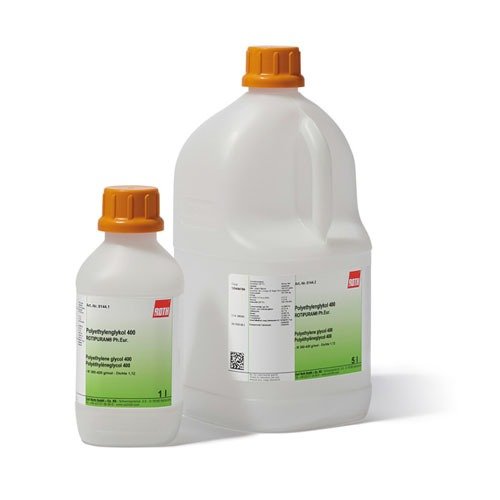
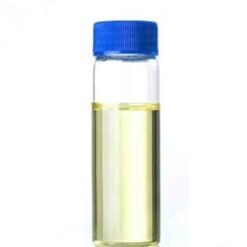
Poly Ethylene Glycol 2.5 kg Lab Grade

₨7,000.00
Properties
product name
Poly(ethylene glycol), average Mn 400
form
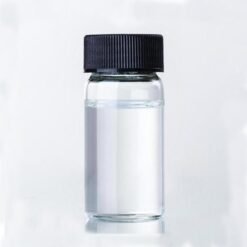
viscous liquid
mol wt
Mn 380-420
average Mn 400
greener alternative product characteristics
Safer Solvents and Auxiliaries
Learn more about the Principles of Green Chemistry.
sustainability
Greener Alternative Product
refractive index
n20/D 1.466
pH
4.5-7.5
viscosity
7.3 cSt(210 °F)(lit.)
mp
4-8 °C (lit.)
density
1.128 g/mL
Ω-end
hydroxyl
α-end
hydroxyl
greener alternative category
Aligned,
SMILES string
C(CO)O
Description
General description
Poly(ethylene glycol) (PEG) is a synthetic, hydrophilic, biocompatible polymer with widespread use in biomedical and other applications. PEGs are non-toxic, FDA-approved, generally non-immunogenic, and frequently used in many biomedical applications including bioconjugation, drug delivery, surface functionalization, and tissue engineering. In drug delivery, PEGs can be used as linkers for antibody-drug conjugates (ADCs) or as a surface coating on nanoparticles to improve systemic drug delivery.
Application
Poly(ethylene glycol) (PEG) has been used as a coating agent for the synthesis and in vitro safety assessment of magnetic bacterial cellulose (MBC) pellicles, performed on porcine aortic smooth muscle cells (PAOSMC). PEG provides a compatible surface for cell culture, since uncoated iron oxide NPs are considered cytotoxic to cells.[1] It has also been used as a plasticizer in investigating the effectiveness of polyvinylpyrrolidone microneedles for transdermal delivery of functional collagen using porcine skin, adult human skin analog and human foreskin. Microneedles obtained, were reportedly characterized by various analytical and bio-analytical techniques.[2]
Solvent for greener fluorination of acetoacetamides with Selectfluor®.
Related products
₨1,500.00
Product
₨12,000.00
Product
₨450.00
Product
₨150.00
Product
₨200.00
₨4,000.00
Product
₨550.00